On Friday I attended a meeting over on the side of the site where the computing group have their offices. This was the weekly meeting of the administrators and users of an impressive compute cluster set up in support of the Next Gen Trigger projects.
I managed to get access to the white CERN Bikes that are available all over the site. I had to take a bike safety course with details on Swiss and French rules of the road and a run down of the most dangerous spots on the CERN site. It works just like a city bike share. There is an app, you find a white bike, scan the code and off you go. It really makes getting to the other buildings much faster.
LINAC4
I like to think of CERN as a medieval town with curvy paths meandering through neighborhoods. Some of them are filled with artiasans, such as the shops for building superconducting magenets. Restaurant 1 is the town square, the center of social life for the community, but dotted here and there are the cathedrals. The imposing structures that house parts of “the machine”.
I’ve walked past one such structure when I’ve been over at that side of the site; LINAC4
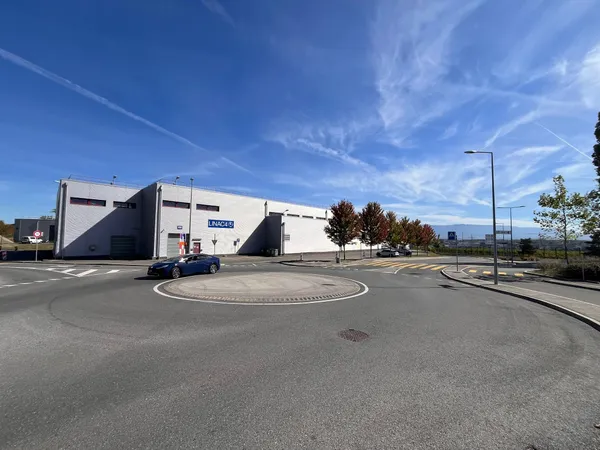
Today I decided to figure out what goes on there. LINAC4 takes in the hydrogen ion, H− (one proton and two electrons) and provides the initial acceleration to 160 million electron volts before stripping the electrons off and passing the energetic protons into the next step in the injection chain, the Proton Synchrotron Booster.
Why hydrogen ions? It makes it easier to layer them with the protons already circulating in the Synchrotron Booster.
How do you strip the electrons off to leave just the proton? Pass the beam through a foil made of carbon just a fraction of a micron thick.
The details of just this one part of the LHC serves to show the incredible complexity of the machine and what an incredible achievement it is, quietly humming away along the boarder of Geneva and France.
Here are some photos from the CERN courier article showing the inner workings of this one piece of the LHC.
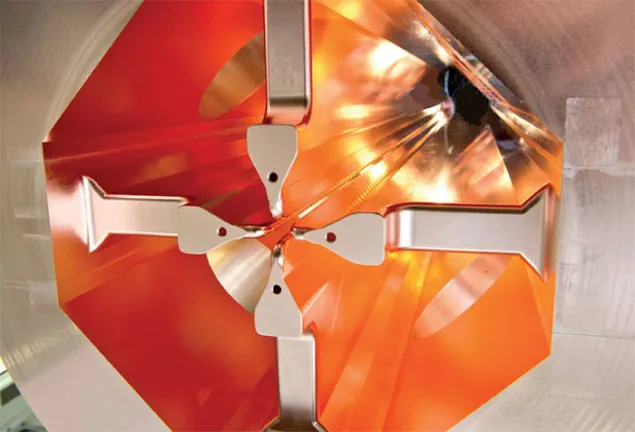
The Linac4 radio frequency quadrupole.
Image credit: M Vretenar
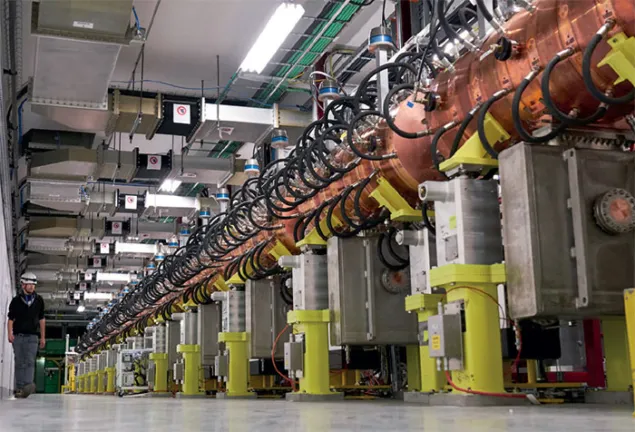
The Linac4 high-energy section.
Image credit: M Brice / CERN.
Forgive me my cathederal analogies. I visited the archelogical site that sits underneath St Pierre in old town yesterday and still trying to make sense of the layered history there.