Over the coffee kiosk at CERN today there is a sign that reads C’est la rentrée. My trusted French-English dictionary tells me that this phrase means both “the return” as well as “Septemeber” as in the first day back from holidays, start of school and the beginning of a new cultural year. In a way, this felt like my first day at school.
The Magic of EDH
CERN is an enormous enterprise. There are thousands of people who work there on any given day. Everything is coordinated by a workflow system called Electronic Document Handling or EDH. Like so much of CERN, this system was developed entirely in-house at the labs.
When all of the stars aligned for me to come on this assignment I had to ask the experiment Team Leader at the University of Illinois to submit a Home Institution Declaration (HID) on my behalf to start the process off. Submitting this document caused a review process inside CERN that resulted in a Short Stay Invitation along with a French Convention D’Accueil which allowed me to apply for my visa.
This same workflow welcomed me on site today and allowed me to sign my contract and get started. It’s a fascinating and baroque process, that handles everything from Payroll to collecitng my emergency contact info, all triggered by various lifecycle events.
Ben Gets Badged
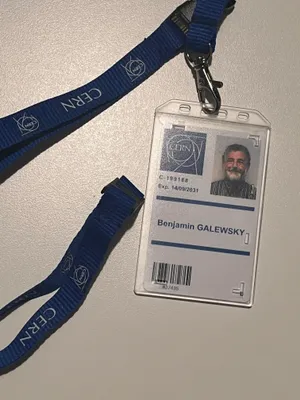
I took the tram out to the main entrance on Esplanade des Particules and walked into the community office. All I had to do was show my passport and was immediately given a day pass which allows me access to the lab campus.
With my day pass in hand I walked over to the main building and again showed my passport which allowed the administrator to send an electronic contract to my email. I electroniclly signed that and was sent back to the community office where a distracted official took my picture against the wall with an iPad and printed out my official badge. I’m in!
R1 Culture
I had some time before meeting with my collaborator. I set up office in the CERN Restaurant 1 (or R1) - this is very French sort of company canteen. With very nice food, coffee, and even a wine selection. There are several different spaces each with different lighting, tables and atmosphere.
I’ve been working in this field for eight years now. It was surprising and wonderful how many people I saw at R1 that I’ve met at conferences over the years as well as collaborators in the Software Institute I work with. I was able to share lunch with a colleague and even plan an outing to this week’s Geneva Art Week.
I received orientation into my new projcect. More about that later, but I’ll leave you with the relocated statue of Shiva, a gift from the Indian government to celebrate the long-standing scientific partnership.
She’s now dancing in a car park while construction is under way, but still a marvelous sight.
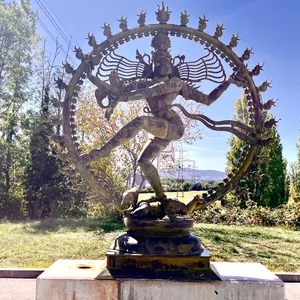
Ananda K. Coomaraswamy, seeing beyond the unsurpassed rhythm, beauty, power and grace of the Nataraja, once wrote of it “It is the clearest image of the activity of God which any art or religion can boast of.”
More recently, Fritjof Capra explained that “Modern physics has shown that the rhythm of creation and destruction is not only manifest in the turn of the seasons and in the birth and death of all living creatures, but is also the very essence of inorganic matter,” and that “For the modern physicists, then, Shiva’s dance is the dance of subatomic matter.”
It is indeed as Capra concluded: “Hundreds of years ago, Indian artists created visual images of dancing Shivas in a beautiful series of bronzes. In our time, physicists have used the most advanced technology to portray the patterns of the cosmic dance. The metaphor of the cosmic dance thus unifies ancient mythology, religious art and modern physics.”